Exterior Algebra
Let  be a real vector space of dimension
  .
.
Definition, Alternating algebraic forms:
For each  , we define
  as the space of alternating -linear maps
  .
.
Note
 ,
, is the dual space of (the space of covectors)
Definition, Exterior product:
For  and
and  , their exterior (wedge) product is given by:

for all  . Where the sum is over all permutations
  of
of  ,
for which
,
for which  and
and  .
.
Note
- The exterior product is bilinear, associative,
- anti-commutative:
 for all and .
Definition, Grassmann Algebra:
Grassmann Algebra is defined by:
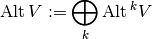
This is a anti-commutative graded algebra. Also called Exterior Algebra of 
In the case of  , we have:
 ,
, ,
, , using Riesz representation theorem,
 , using the map
  .
.
Basis
Let  be a basis of and
  the associated dual basis for
  (
( ).
).
For any increasing permutations  , we have:

thus the  algebraic -forms
  ,
form a basis for and
,
form a basis for and  .
.
Definition, Interior product:
Let  be a -form, and
  . The interior product of and
  is the
  -form
-form  defined by:

- We have for
 ,
,  and :
and :

Definition, Inner product:
If is has an inner product, then is endowed with an inner product given by:

where the sum is over increasing sequences  , and
, and  is any orthonormal basis.
Orientation and Volume form
Todo
add Orientation and Volume form
Definition, Pullback:
A linear transformation of vector spaces  induces a transformation
 , called the pullback, and given by:

The pullback acts contravariantly: if
 then,
then,

Let V be a subspace of W. For the inclusion  , we can define its pullback
  :
this is a surjection of
:
this is a surjection of  onto
onto  .
.
If W has an inner product and  is the orthogonal projection. We can define its pullback
  :
this an injection of onto .
:
this an injection of onto .
Let us consider the composition :  shortstack{
 \
\  } shortstack{
 \ } , and its pullback
  .
.
Definition, The tangential and normal parts:
- associates for each
 its tangential part
  with respect to :

 associates for each its normal part
  with respect to .
The tangential part of vanishes if and only if the image of in vanishes.
Let be an oriented inner product space, with volume form  . Let .
We can define a new linear map
. Let .
We can define a new linear map  as the composition of
  such as:

and the canonical isomorphism of  onto
onto  , and using the Riesz representation theorem,
there exists an element
, and using the Riesz representation theorem,
there exists an element  such that :
  , i.e.:

Definition, The Hodge star operation:
The linear map which maps onto 
 is called the Hodge star operator.
- If
 is any positively oriented orthonormal basis, and a permutation, we have

 , thus the Hodge star is an isometry.
 and
and 
- the image of
 in vanishes if and only if vanishes.






Exterior Calculus on manifolds and Differential forms
Let  be a smooth manifold, of dimension .
 we denote by
  the tangent space. This is a vector space of dimension ,
- tangent bundle
 ,
, - Applying the exterior algebra to the tangent spaces, we obtain the exterior forms bundle, whose elements are pairs
 with
with  and
and  .
. - a differential -form is a section of this bundle. This is a map which associates to each an element
 ,
, - if the map
 is smooth (whenever
  are smooth), we say that is a smooth differential -form,
 - we define
 the space of all smooth -forms on ,
  ,
,- if the map
 is
is  , we define differential -forms with less smoothness
  .
.
Let be a smooth manifold, of dimension .
Exterior product:
if  and
and  , we may define
  as
as  and the Grassmann algebra
Differential forms can be differentiated and integrated, without recourse to any additional structure, such as a metric or a measure.
Exterior differentiation:
For each-form
, such as:

where the hat is used to indicated a suppressed argument.
This defines a graded linear operator of degree  , of
, of  onto .
We have the following properties:

 ,
,- (Pullback) let
 be a smooth map of onto
  . Then
  and
and  ,
, - (Interior product) the interior product of a differential -form with a vector field ,
- we obtain a -form by :
 ,
, - (Trace operator) the pullback
 of
of  is the trace operator
Integration:
- If
 is an oriented, piecewise smooth -dimensional submanifold of , and is a continuous -form, then th integral
  is well defined :
- [0-forms] can be evaluated at points,
- [1-forms] can be integrated over directed curves,
- [2-forms] can be integrated over directed surfaces,
- (Inner product) The
 -inner product of two differential -forms on an oriented Riemannian manifold is defined as :

The completion of in the corresponding norm defines the Hilbert space  .
.
We have the following results:
- (Integration) if is an orientation-preserving diffeomorphism, then

Theorem, Stokes theorem:
If is an oriented -manifold with boundary  , then

Theorem, Integration by parts:
If is an oriented -manifold with boundary , then

Sobolev spaces of differential forms
As for the classical case, we can define the Sobolev spaces as:
 is the space of differential -forms such that
  .
. . The associated norm is :

 coincides with
  ,
, coincides with
  ,
,- for
 , we have
  , strictly.

Cohomology and De Rham Complex
The De Rham complex is the sequence of spaces and mappings

Since, , we have

If is an oriented Riemannian manifold, we have the following cohomology:

The coderivative operator  is defined as:

- we have

 is a graded linear operator of degree
  .
.- is the formal adjoint of
 whenever or
  vanishes near the boundary.
 - we define the spaces
we have
.

- we obtain the dual complex

Cohomology with boundary conditions
Let  be the subspace of of smooth -forms with compact support. We have
  .
.
The De Rham complex with the compact support is

Recall that the closure of in  is
is

The version of the last complex is

Definition, Harmonic forms:
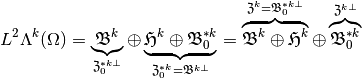
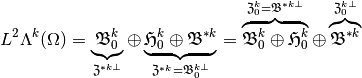
The harmonic -forms are the differential -forms that verify the differential equations
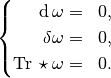
this defines the following space,

We can also define the following space,

As we can see,  .
.
Proposition, Poincaré duality:
There is an isomorphism between the th De Rham cohomology space and the  th cohomology space with boundary conditions.
Homological Algebra and Hilbert complexes
Homological Algebra
- A cochain complex is a sequence of vector spaces and linear maps
- -cocycles
 ,
, - -coboundaries
 ,
, - -cohomology
 ,
, - we say that the sequence is exact, if the cohomology vanishes (i.e.
 ),
), - Given two cochain complexes
 , a cochain map
  (such as
  )
)

 maps -cochains to -cochains and -coboundaries to -coboundaries, thus induces a map
  .
.
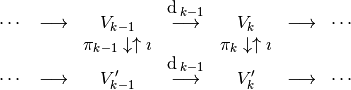
Let  be two cochain complexes,
The inclusion
is a cochain map and thus induces a map of cohomology  ,
,If there exists a cochain projection of
onto  , (this leads to
  ) so
) so  .
.
Thus,  is injective and
  is surjective. Hence, if one of the cohomology spaces
  vanishes,
then so does
vanishes,
then so does 
Cycles and boundaries of the De Rham complex
- -cocycles



- -coboundaries


- each of the spaces of cycles is closed in
 (
( ), as well in .
 - each of the spaces of boundaries is closed in .
- let
 denotes the orthogonal complement in ,